Model Room is a collection of mathematical curves and surfaces, molecular structures, planetary interiors, the organs of a human body and the galaxy all of it sits in, rendered at true scale in a room you can walk around. Nineteenth-century universities kept rooms like this — shelves of plaster surfaces beside ball-and-stick models — because some things only make sense once you can step around them.
A hundred and twenty-nine entries, in four galleries.
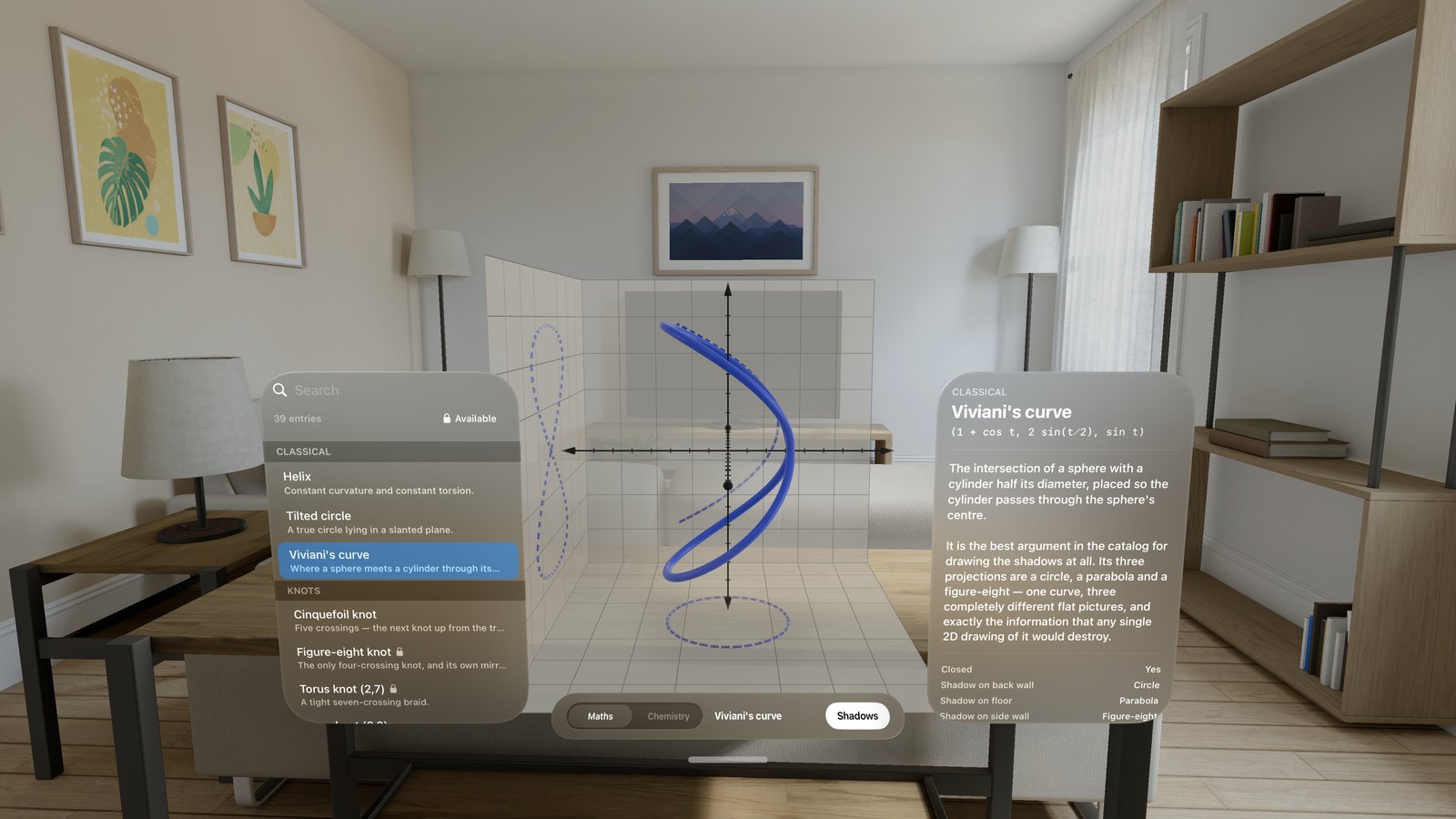
Viviani's curve, with its shadow cast onto all three walls — a circle, a parabola and a figure-eight, from one curve.
Four Galleries, One Room
53 entries
Mathematics
Forty-one space curves inside a coordinate box, each casting a dotted shadow onto all three walls. Knots that cannot be untied, and one that looks knotted but isn't. The Lorenz attractor, integrated rather than plotted. And twelve surfaces, the plaster models the room is named after: a Möbius strip with one side, a Klein bottle with no inside, Boy's surface, coloured by their own curvature.
50 entries
Chemistry
Structures in the CPK colours chemists read without thinking, in two representations: ball-and-stick for the skeleton, and space-filling, which draws every atom at its true van der Waals radius. Small molecules and coordination shapes, cages and crystals, acids, bases and the ions they come apart into — and a shelf of medicines.
11 entries
Space
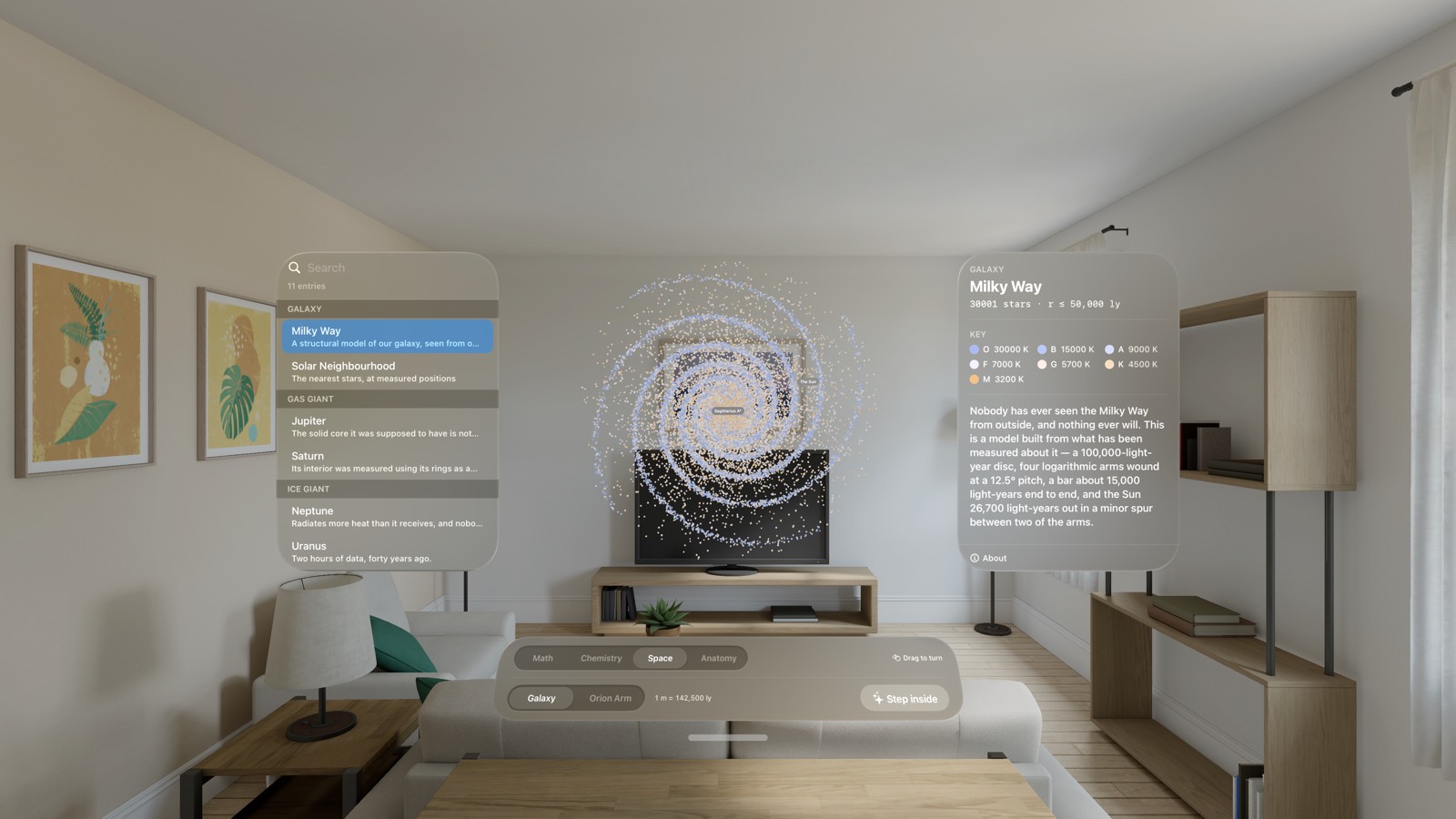
Nine bodies, each viewable as itself, as its system, or opened along the equator to show what it is made of. Earth's crust drawn as the hairline it really is. Jupiter's Galilean moons keeping their exact 1:2:4 resonance. And the Milky Way around them — thirty thousand stars from measured structure, with the Sun 26,700 light years out — which you can look at from outside or step inside.
15 entries
Anatomy
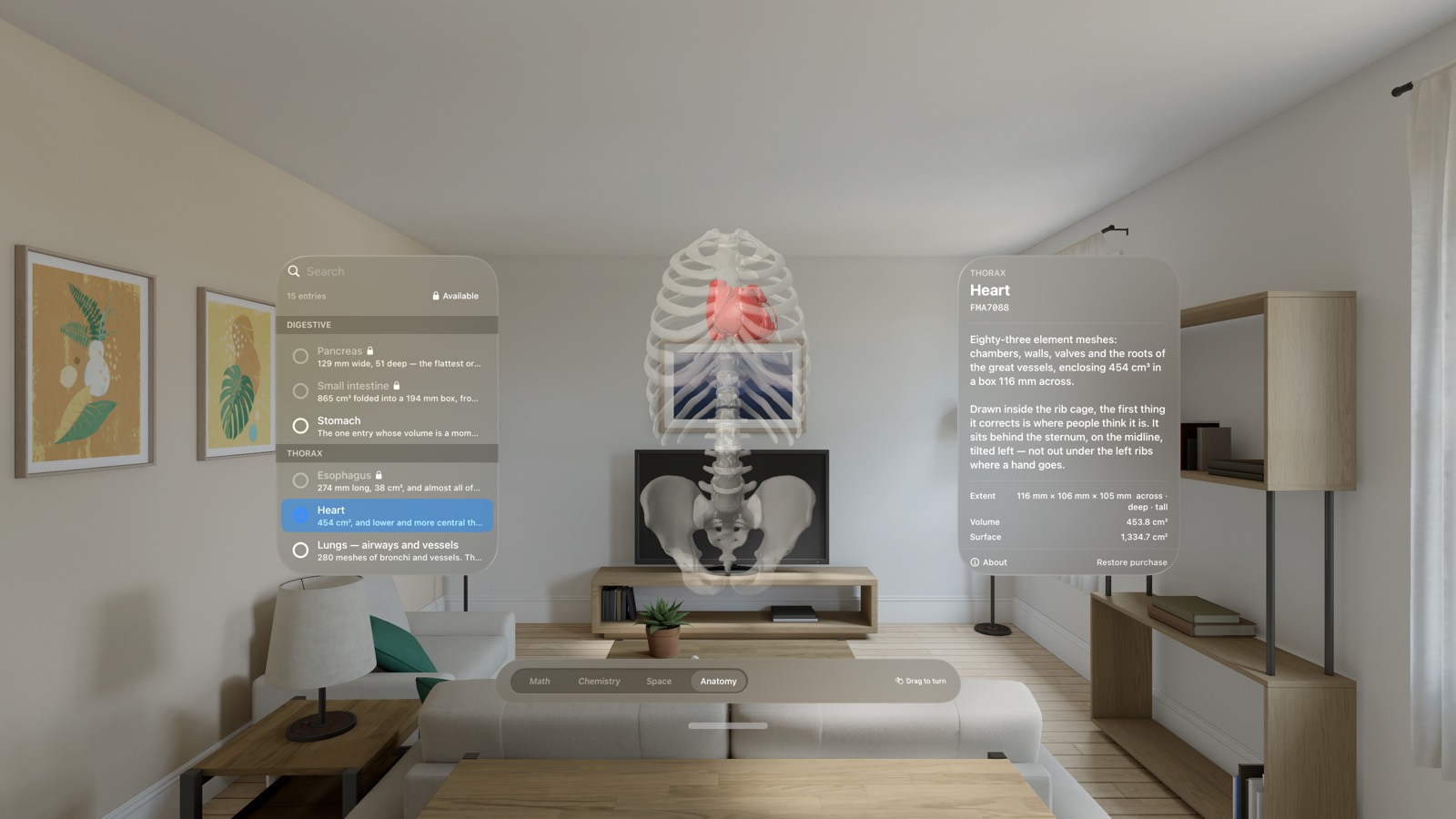
Fifteen organs from BodyParts3D — one adult body segmented from MRI, so each entry describes a particular organ rather than a typical one. Nothing is scaled to fit: every organ the size it is, in the place it is, inside the torso skeleton that holds it, with the bile and pancreatic ducts and the ureters that join them. Tick on as many as you like.
The Cases That Only Work in 3D
- Methane — a real 109.47° tetrahedron, which a flat cross drawing makes look like four right angles.
- Cyclohexane, chair and boat — the same molecule, two shapes, and the reason three dimensions matter.
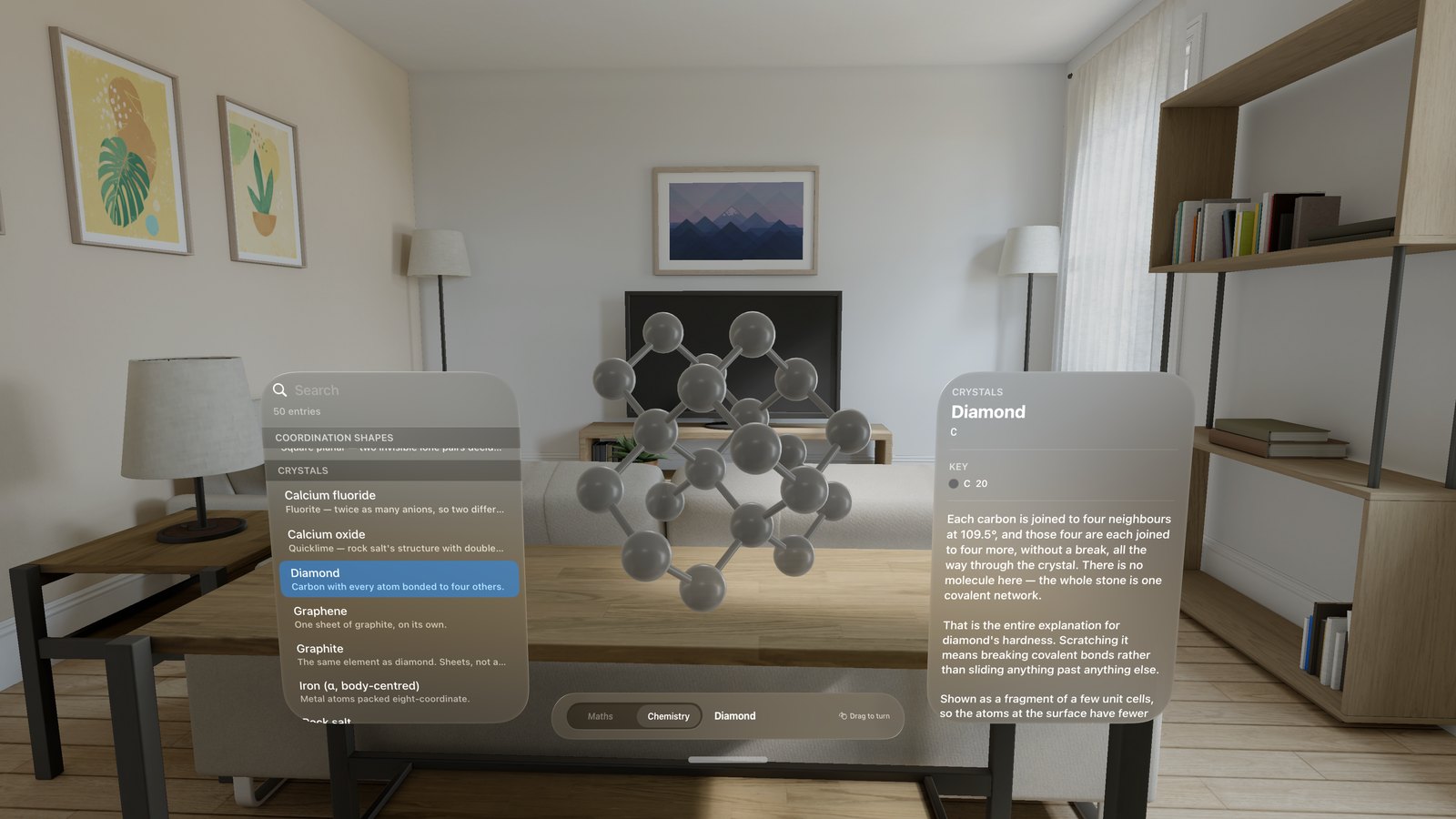
- Diamond and graphite — identical atoms, opposite properties, entirely because of arrangement. Graphite's layers are drawn with no bonds between them, because there are none.
- Cisplatin and transplatin — same formula, same bonds, one a cancer drug and one inert. The isomerism is the pharmacology.
- Viviani's curve — one curve whose three shadows are a circle, a parabola and a figure-eight. No single flat drawing can hold that.
- The liver and the right kidney — drawn at true size in their own positions, the liver visibly sits on the kidney, and the pancreas lies across the spine rather than beside it.
- Earth, opened — the crust at the thickness it actually is, which every textbook cutaway exaggerates and no one who has only seen those pictures expects.
Screenshots — Apple Vision Pro
On Meta Quest Out now
Model Room is on Quest 3 and Quest 3S. It is the same catalogue — all 129 entries, the same geometry, computed from the same published data — rebuilt in Unity for Meta Horizon OS rather than ported screen by screen. Where the two versions differ, they differ because the headsets do.
What is different about the Quest version
- Your room, not a window. visionOS gives an app a bounded volumetric window, and the coordinate box was aligned to its faces. Quest has no such thing, so the box is a model standing in passthrough: it arrives in front of you, at table height, wherever you are facing when the app opens — including the next time you open it in a different room.
- Panels float around the model. The browser, the details and the controls are world-space panels arranged around the box — the visionOS layout, rebuilt in Unity's UI rather than SwiftUI. Everything is reachable with a ray from where you are standing.
- Point, press, and grab with the Touch controllers. Grab the box and turn it, and one sweep brings any face to the front; a Level button puts it back square.
- Stepping inside the galaxy is one move. On Quest the walk-in draws a dark sky over passthrough and the room becomes the Milky Way, with Sagittarius A* at the centre — no second scene to open and close.
- Everything is open from the first launch. The Horizon Store gives you thirty minutes with the whole app before you decide — all 129 entries, nothing locked. There is no in-app purchase: the decision to buy is made at the store, and the app you install is the whole thing.
What is the same
Every geometry is computed from published data, every entry is written to be read, and nothing is scaled to flatter a picture. The maths tolerances, the curvature arithmetic and the measured bond lengths are the visionOS build's, carried across rather than re-typed.
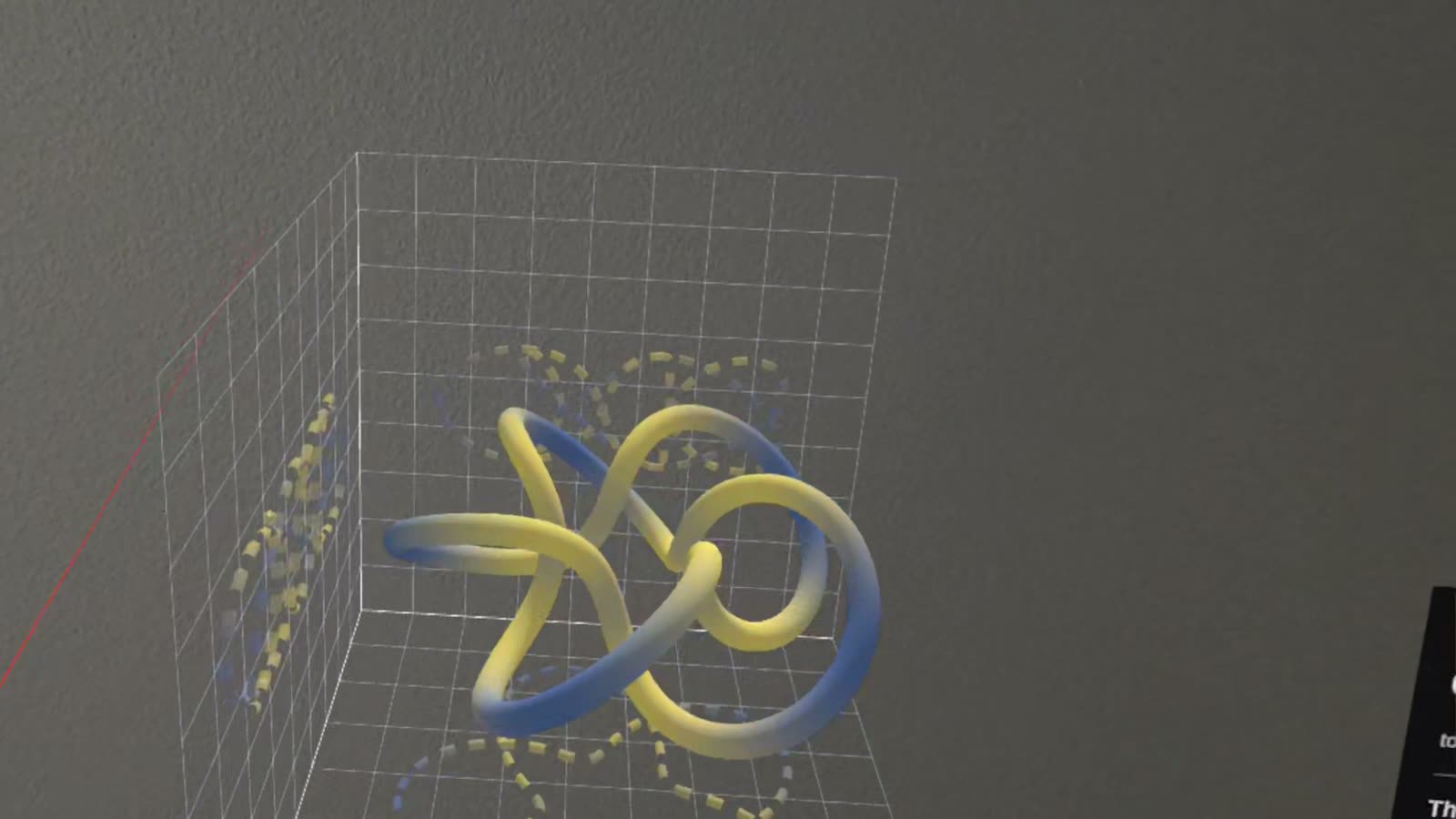
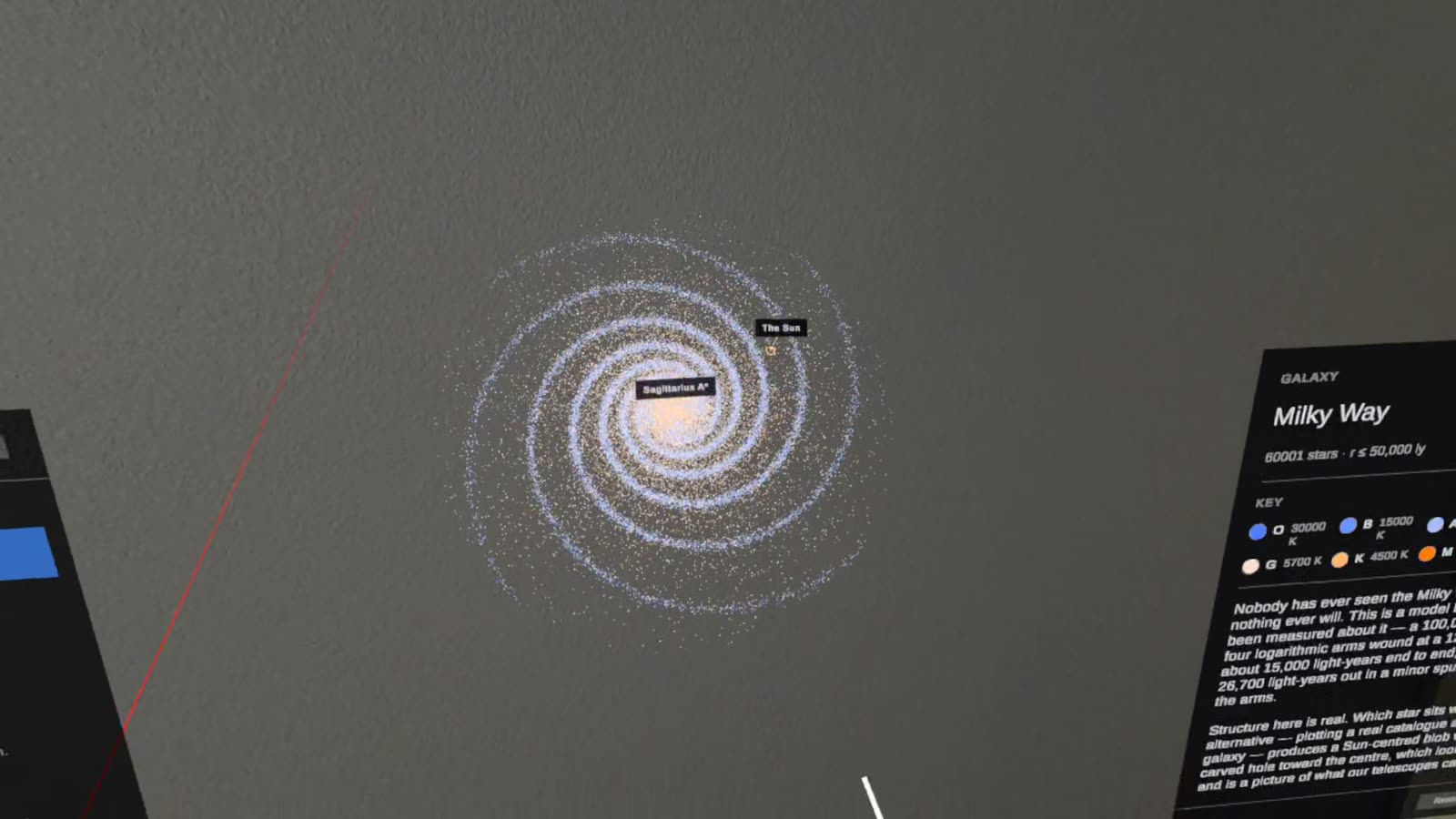
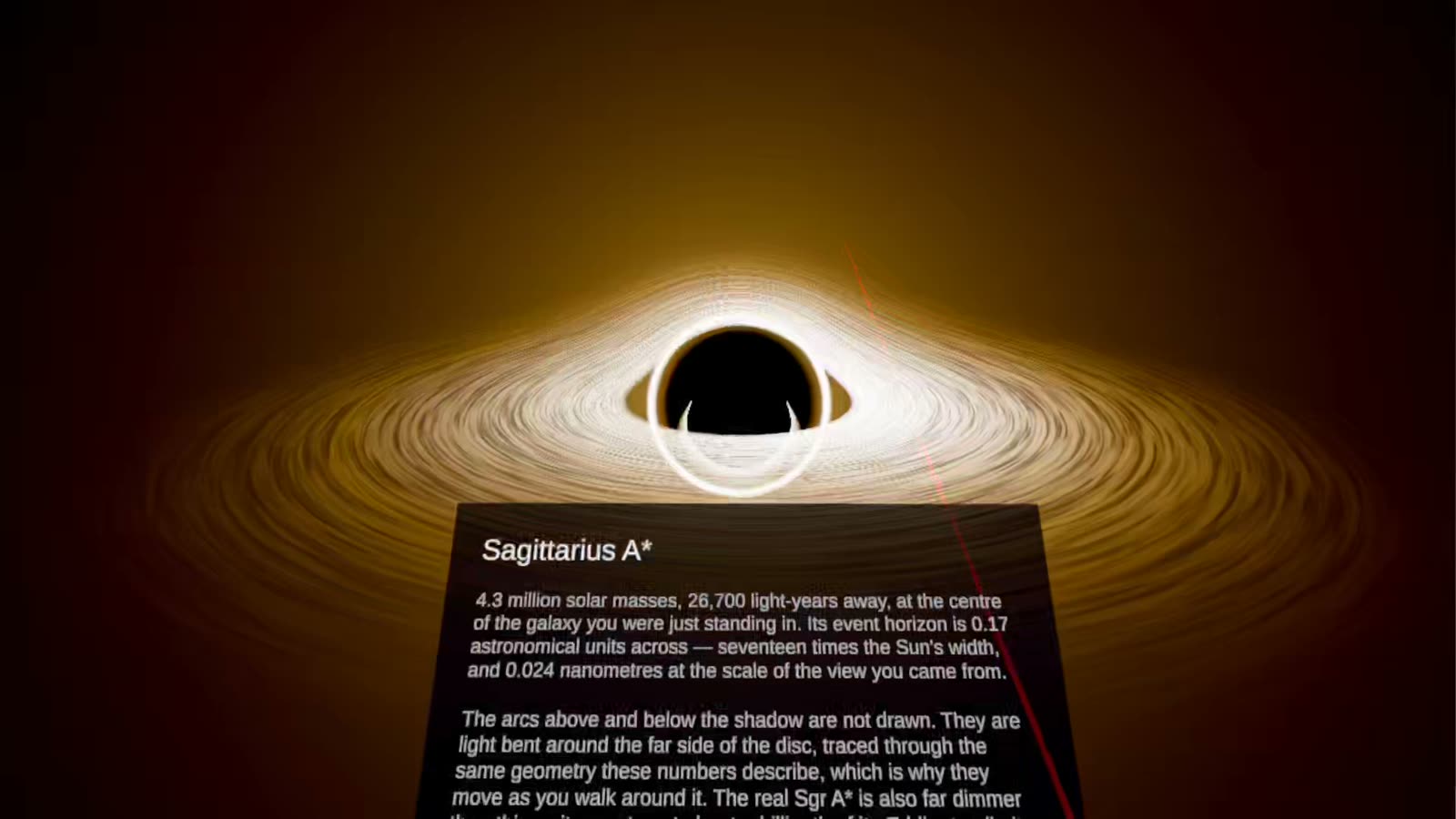
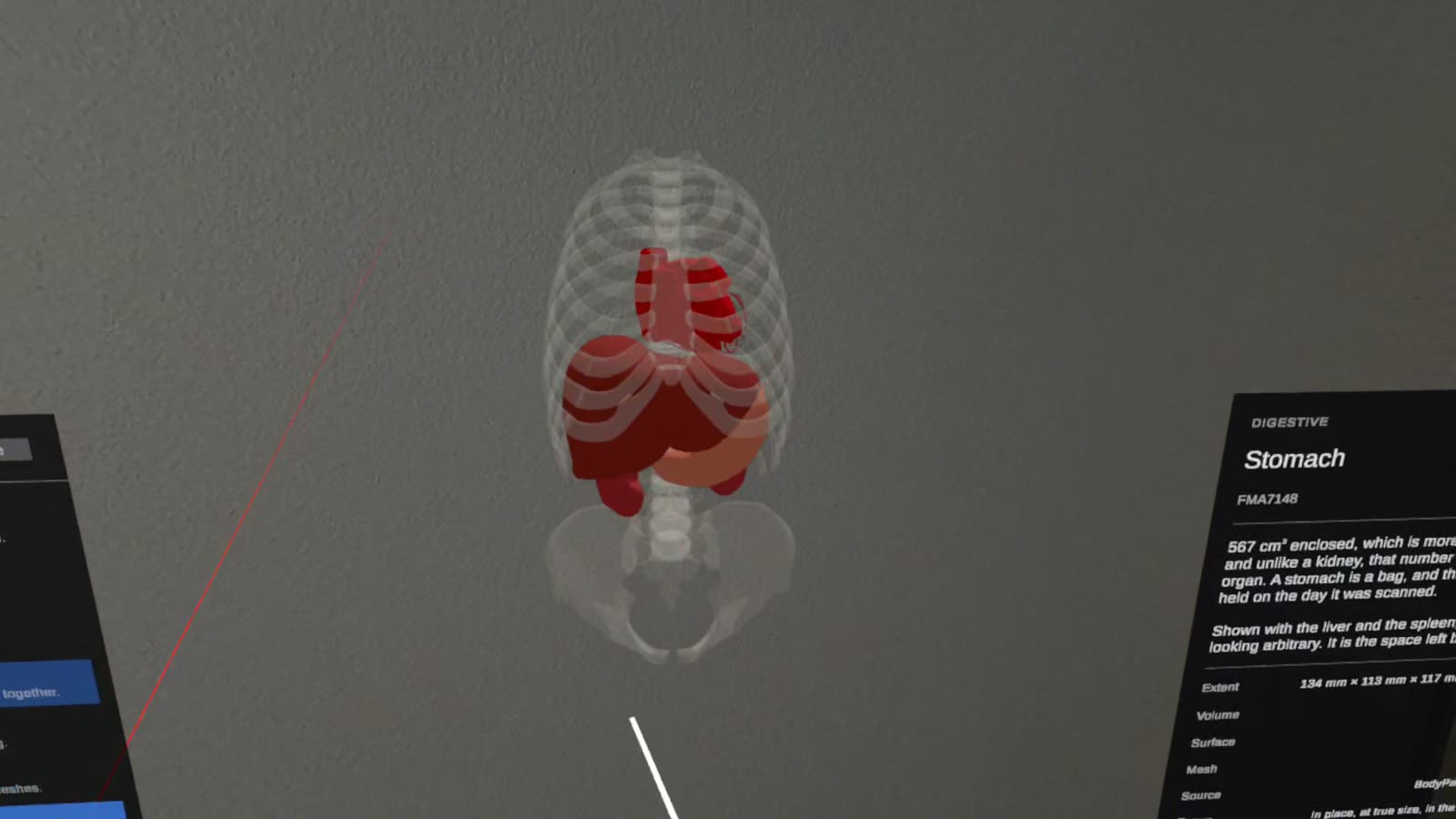
Captured on a Quest 3. Passthrough is the room you are actually standing in.
Features
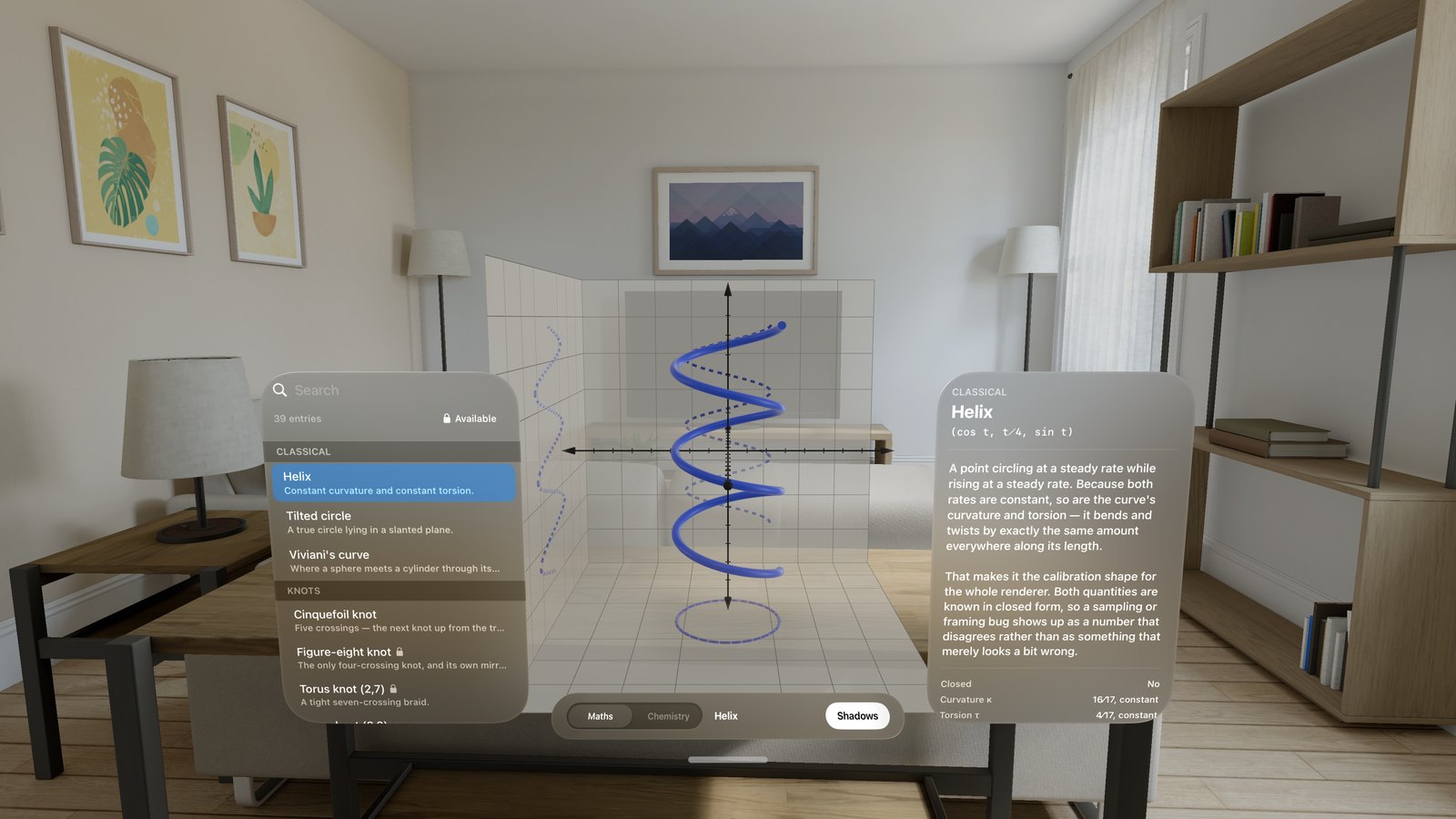
- The model stands in your room — a volumetric window on Apple Vision Pro, a box you place in passthrough on Quest. You change the view by moving, and a drag turns the model when you would rather not walk.
- Every geometry is sourced — bond lengths and angles from published experimental structures, interior boundaries from seismology and from spacecraft, organ measurements computed from the mesh on screen. Nothing is sketched by eye, and each entry names where its geometry came from.
- The proportions are right — and wherever a picture has to be compressed to be legible at all, such as moon orbits and solar-system spacing, the app says so where it does it.
- Written to be read — every entry explains what you are looking at and why it is worth looking at: what the shape causes, or disproves, or what a flat picture gets wrong about it. Alongside it, the formula, the measured values and a colour key.
- Shadows on three walls — each curve's projection is drawn on the floor and both walls, so you can see what it does in every coordinate at once.
- Step inside the galaxy — the Milky Way leaves the box and becomes the space around you, with Sagittarius A* at the centre, labelled as a rendering rather than a photograph, because that is what it is.
- Watch the disc turn — inside the galaxy, press play and the clock runs a hundred million years either side of now, there and back rather than looping. The rotation is differential, so the inner disc winds almost a full extra turn on the rim: the winding problem, watched rather than described.
- Grouped and browsable — the catalogue is organised by category, with search on Apple Vision Pro.
- Works offline — the whole catalogue is built into the app. No accounts, no analytics, no advertising.
Specifications
Meta Quest 3 and 3S (Horizon OS)
Pricing
Apple Vision Pro
47 entries free, across every category
One in-app purchase unlocks the rest permanently, including all future additions. No subscription.
Meta Quest
Free 30-minute trial, then buy once
Try the whole catalogue — all 129 entries — for thirty minutes on the Meta Horizon Store, then keep it for $7.99. No in-app purchases, no subscription, and nothing held back inside the app.
Quest 3 and Quest 3S — free 30-minute trial
Contact
Questions, feedback, or a structure you would like added? Email me at
fftu0316@gmail.com
Other Apps
Art Puzzle VR — Classic art jigsaws on Vision Pro and Quest
XR GLB Viewer — View 3D models on Vision Pro
180 Theater — Play VR180, 360, and 2D video on Vision Pro